About Rhize services
This document covers the major components of Rhize’s architecture and services.
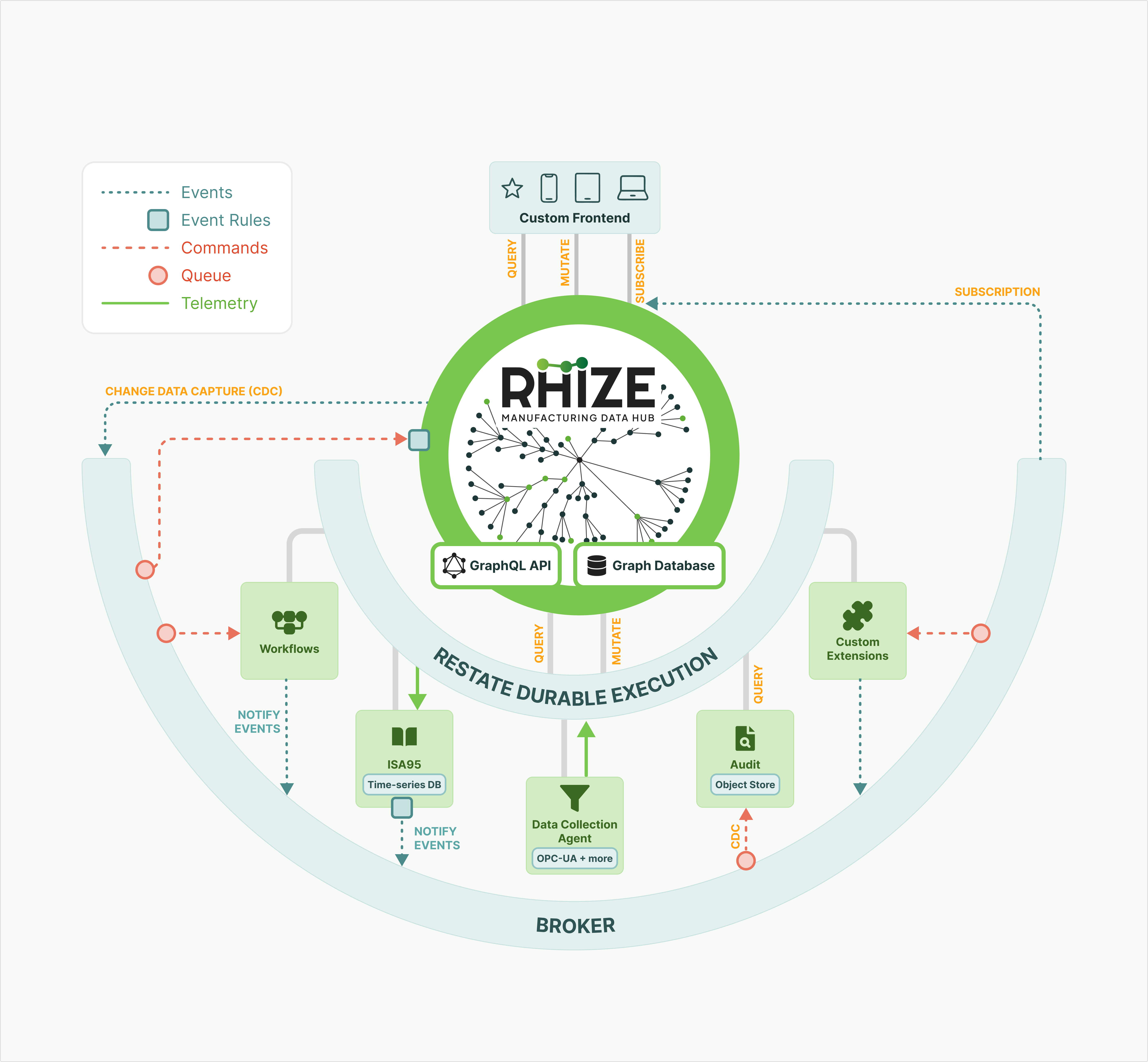
Core backend infrastructure
The following services are the key components of the Rhize backend.
RhizeDB (BaaS). An ACID-compliant graph database, exposed to users through a GraphQL API.
ISA-95. The logic and schema for the ISA-95 data model.
The ISA-95 service also contains helper functions to process ISA-95 entities. These include version control, property inheritance, event processing, and historization of equipment property data.
Workflow. The workflow service processes the logic configured through the nodes and connections of a user-defined BPMN workflow.
Agent. The Rhize agent bridges your plant telemetry and events with the Rhize data hub. It collects data emitted from the plant and publishes it to the message broker.
Restate. Restate is the engine for stateful, durable execution. It serves multiple functions in the Rhize application stack:
- Durable execution. Restate journals each step of an executing service. Even in the case of massive failure, such as a power outage, execution resumes from the last completed step.
- State management. Restate stores state for services like ISA-95 and workflow, enabling stateful functions with durable execution.
- Concurrency control. Restate ensures data integrity and idempotency for parallel processing.
- Decoupling. Rhize services communicate through Restate’s durable execution engine rather than directly with each other. This reduces complexity and ensures redelivery if a service is unavailable.
- Extensibility. Users can write Restate handlers to deploy custom services.
Kubernetes. Rhize deploys on Kubernetes. Manufacturing is data-intensive, and outages can have severe consequences. Kubernetes is the core infrastructure for high availability and scalability. As a de facto standard, Kubernetes has a diverse ecosystem, providing many tools and resources to extend and learn about the system.
Rhize is agnostic about whether you deploy on-premises or in the cloud.
For local testing, we also offer customers a Docker Compose environment.
Rhize frontends
Apart from your custom frontends, the Rhize deployment has the following default services.
Admin UI. The core Rhize interface to model entities, write BPMN workflows, explore queries, administer users, and so on.
Portal. The Rhize portal provides a frontend to aggregate built-in and custom Rhize applications.
Optional services
These third-party services are often found as defaults in Rhize deployments.
Audit. A record of all changes to the database, stored in object store.
Grafana. Observability dashboards and tracing.
QuestDB. Rhize’s default time-series database.